

On Foot in Tiger Country: How a Walking Safari in Bardia Works
How a day tracking tigers on foot in Bardia works: reading pugmarks and alarm calls, the naturalists, the rules, what to wear, and how walking stays safe.
27 November 2026
The sand at the edge of the Karnali is still cool at first light. Across it runs a line of round prints, each as wide as a hand, the toes in front, no claws showing. The naturalist kneels, looks at the edges of the print, and says quietly that the tiger passed an hour ago, walking, not hurrying, towards the grass.
This is how a tiger is tracked on foot in Bardia National Park, in Nepal's far west. Few places in the world allow it. This is how the day works, what you are reading as you go, and how a walk among tigers, rhinos and wild elephants is kept safe.
Why on foot
In most tiger country, visitors stay in a vehicle. In India's tiger reserves, walking is generally not permitted. In Bardia, guided walks are part of visiting the park, and they are the heart of tiger tracking here.
On foot you hear more. The forest answers to a vehicle by going quiet. It answers to a few people walking slowly by going on as before. You notice the fresh scrape on a track, the smell of a kill, a crow circling low. And when a tiger does appear, you meet it at its own level, on its own ground.
Africa has a great walking tradition too. The walking safari as a way of travelling began in Zambia's South Luangwa Valley in the 1950s, with the conservationist Norman Carr. If you have walked there, Bardia will feel familiar in spirit: the low voices, the single file, the naturalist reading the ground. The difference is the cat you are following, and the forest it hides in.
A day on the trail
The day begins before sunrise, when the forest is coolest and the animals most active. After tea, you walk out with your naturalists through sal forest and along the riverbanks, stopping often to read what the night has left behind.
By mid-morning, if the signs point somewhere, you may settle in at a quiet place above a river crossing or the edge of a grassland, and wait. Waiting is most of tiger tracking. It can last an hour or a whole morning. Many travellers say these still hours, with kingfishers on the water and deer coming down to drink, are what they remember most.
In the heat of the day you rest. Late afternoon brings a second walk, or a drive by open vehicle, or a drift on the river, depending on where the tiger has been. On our journey, Realm of the Tiger, the three days in the forest move between all three, so the search follows the signs.
What you are reading
Pugmarks. A tiger's print is round, with four toes and a broad pad, and no claw marks, because a tiger walks with its claws drawn in. The size and shape tell a naturalist whether it is a male or a female, and the sharpness of the edges tells how long ago it passed.
Scrapes and scent. Tigers mark their territory by scraping the ground with their hind feet and by spraying trees and bushes. A fresh scrape on a forest track means a tiger is patrolling there.
Alarm calls. The forest has its own warning system. Spotted deer give a sharp, repeated bark. Sambar give a deep honk. Langur monkeys, high in the trees, cough out an alarm that carries a long way. Peafowl call out too. A chorus of alarms moving through the forest often means a tiger is walking through it.
The river. In the dry months, from February to May, tigers come to the water to drink and to cool off, and the riverbanks become the best place to read fresh sign.
How walking stays safe
Walking among wild animals carries a real risk. We say this plainly because it is true, and because the people who walk with you take it seriously every day.
The animal most walkers think of is the tiger. In practice, the rhino and the wild elephant are as much a concern on foot. A rhino can charge when surprised at close range. A bull elephant deserves a wide berth. Serious incidents are rare, but they happen. In September 2024 a senior nature guide was killed by a rhino during a jungle walk in a community forest near the park, and two walkers were injured. In 2016 a tiger attacked a guide walking with a visitor in Bardia. The visitor climbed a tree, and both were rescued.
This is why walking in Bardia is always done with experienced naturalists who know these animals and this ground, and why the rules matter:
- Walk in single file, close together, and quietly. Speak in low voices or not at all.
- Follow every instruction at once, without discussion.
- Never run from a tiger. Stand together, face it, and back away slowly when your naturalist says to.
- With a rhino, move behind a large tree or climb one if your naturalist tells you to.
- With elephants, keep a long distance. Your naturalists will read the herd and decide.
- Wear quiet, muted colours and keep your phone silent.
Before the first walk, your naturalists will brief you on exactly what to do with each animal. The decision to turn back, or to change the plan for the day, is always theirs, and it is never a debate. How we work sets out how we choose the people you walk with.
How fit do you need to be?
The ground in Bardia is low and flat, around 150 metres above the sea, so there is no climbing and no altitude. The challenge is time and heat. Walks last a few hours, often with long stops, and the afternoons from April onwards are hot. If you can walk comfortably for a morning on level ground, you can track a tiger. Days by open vehicle and by river are there for anyone who prefers them.
What to wear and bring
- Clothes in quiet greens, browns and khaki. Avoid white and bright colours.
- Long, light trousers and a long-sleeved shirt, against sun, insects and grass.
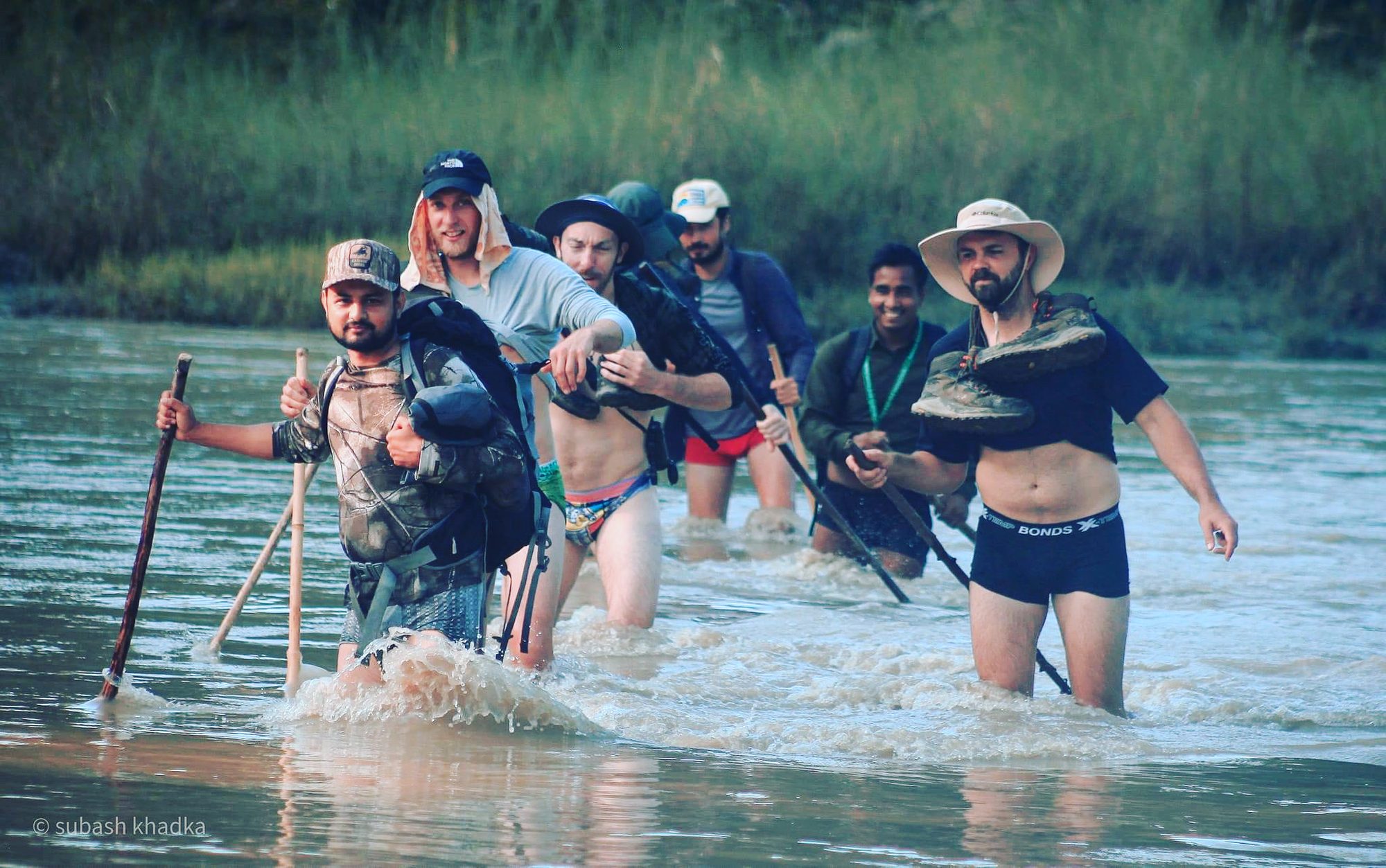
- Comfortable closed walking shoes that you do not mind getting wet at river crossings.
- A hat, sun cream and a refillable water bottle.
- Binoculars, ideally your own pair, and a camera with a long lens if you photograph.
- A light jacket for early mornings from December to February, which can be cold and foggy.
Questions we are often asked
Is it safe to walk in tiger country? It carries a real but small risk, and it is managed by experienced naturalists, clear rules and good judgment. Serious incidents are rare.
What happens if you meet a tiger on foot? You stand together, face it and stay calm. Most tigers move away from people. Your naturalists will tell you when to back away.
How fit do I need to be? Able to walk for a few hours on flat ground in warm weather.
What should I wear? Muted greens and browns, long light trousers and sleeves, and closed shoes.
Can you walk with tigers in India? Generally not. In India's tiger reserves, safaris are by vehicle. Nepal is one of the few places where tigers are tracked on foot.
Begin with a conversation
Tell us when you would like to walk the forest, and anything we should know about your pace. Your journey designer in Kathmandu will reply promptly and compose Realm of the Tiger around you.
Sources
- Walking in Nepal, vehicle safaris in India: Responsible Travel and Bandhavgarh FAQs.
- The walking safari in South Luangwa, Norman Carr, 1950s: Bushcamp Company and Royal Zambezi Lodge.
- The September 2024 rhino incident: Republica, September 2024.
- The 2016 tiger incident: The Guardian, February 2016 and NL Times.
- What to do with each animal on foot: The Longest Way Home, Bardia guide and Backpack Adventures.
- Rhino, tiger and elephant attacks in the Terai: Asia News Network.
- Altitude, the dry season and the river: Nepal Tourism Board and our Realm of the Tiger page.
Realm of the Tiger
See the journey