

Tiger Safari in India or Nepal? An Honest Comparison
India gives the best odds of a wild tiger. Nepal lets you track one on foot, in quiet. Parks, rules, seasons and crowds compared, with the latest figures.
27 November 2026
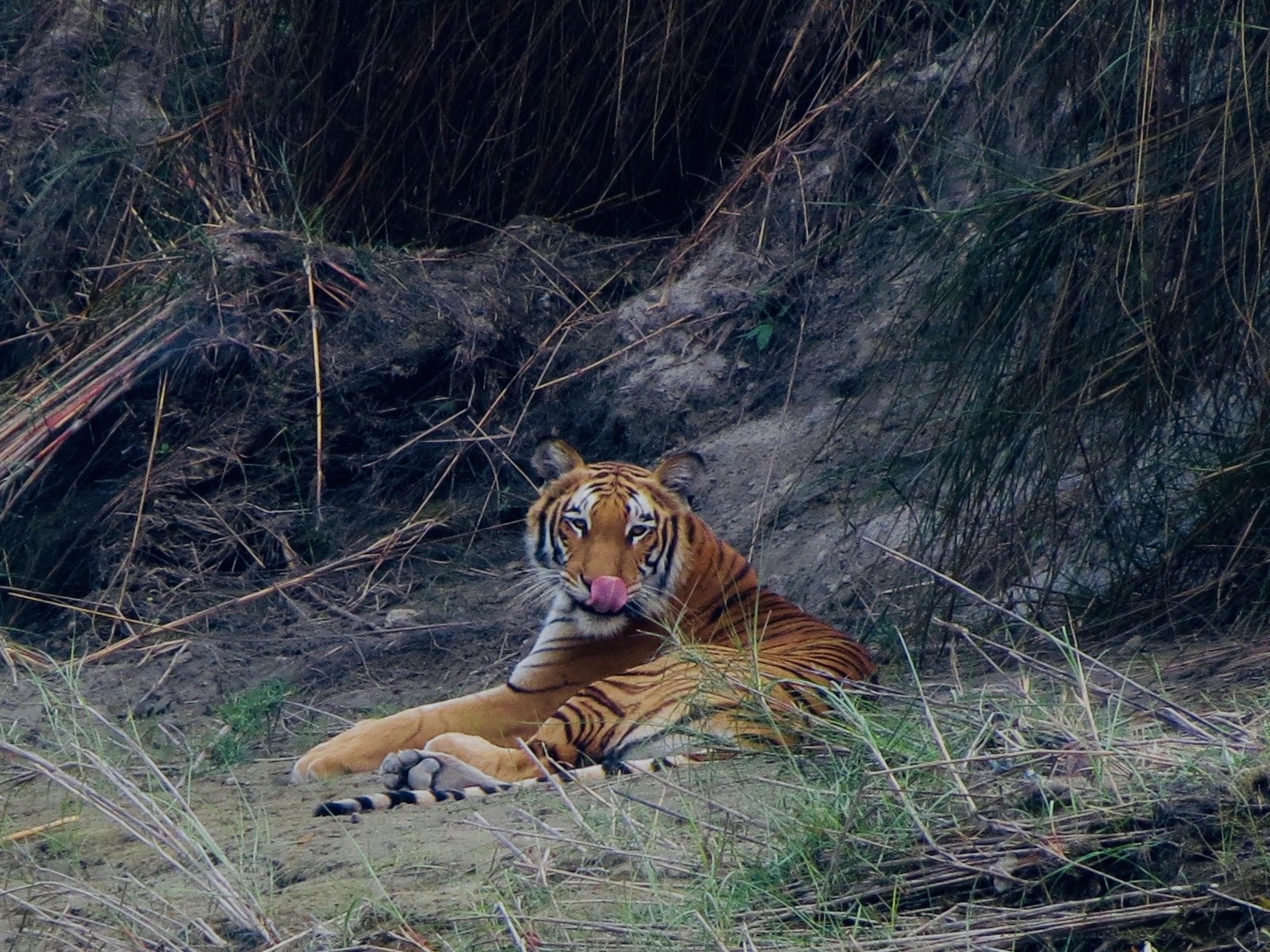
Almost every wild tiger left on earth lives in South Asia, and most of them live in India. If you want to see one, the first decision is the country. India and Nepal share the same tiger, the same forests of sal and tall grass, even the same border, along which tigers cross without papers. What differs is how you meet them.
This is a fair account of both, written from Kathmandu, with the latest figures. We will say plainly where India is stronger.
The short answer
If your one aim is to see a tiger, with the best odds in the shortest time, go to one of India's leading reserves and book several drives. If you want to track a tiger on foot, in quiet, on a journey that can also take in the Himalaya, come to Bardia in Nepal, and give it four or five days.
Many of the travellers we speak with have done the first already. They come to Nepal for the second.
The numbers
India's last national count, in 2022, estimated 3,682 wild tigers, around three quarters of all the wild tigers in the world. A new Indian count ran through 2026, and its results are expected in 2027.
Nepal counted 429 wild tigers in its 2026 census, more than three times the 121 of 2009. They live in five protected areas along the southern lowlands: Chitwan (145), Bardia (112), Parsa (71), Banke (51) and Shuklaphanta (50).
India has more tigers and more places to find them. Nepal has fewer, concentrated in a handful of parks, and one of the fastest recoveries anywhere.
Seeing a tiger: where India leads
India's best-known reserves, Ranthambore in Rajasthan and Bandhavgarh, Kanha, Pench and Tadoba in central India, give the highest odds of a sighting in the world. Their tigers are used to vehicles and are often seen in daylight on open tracks and at waterholes. Even Responsible Travel, which sells both countries, says plainly that your chances are better in Ranthambore or Pench than in Chitwan or Bardia.
If a single good sighting in three days matters more than anything else, India is the honest answer.
How you meet the tiger: where Nepal is different
In India, the tiger is seen from a vehicle. The rules are strict and sensible. Visitors drive in a set zone, at a set time, in an open vehicle with a forest guide. In the tiger reserves of Madhya Pradesh, which include Bandhavgarh, Kanha and Pench, walking is not permitted, and guests may not step out of the vehicle.
In Bardia, much of the tracking is done on foot. You walk with naturalists through sal forest and along the banks of the Karnali, reading pugmarks in the sand, listening for the alarm call of a deer or a langur, then waiting quietly where a tiger is known to cross. Days by open vehicle and a drift down the river fill in the rest. Responsible Travel makes the same point: in Nepal you can track tigers on foot, while India offers vehicle safaris.
A tiger seen from the ground, after an hour of reading its tracks, is a different experience from a tiger seen from a jeep. Neither is better for everyone. They are simply different.
Crowds
India's reserves are very popular. In Bandhavgarh, safari permits for the best core zones go on sale 120 days ahead and can sell out quickly. In spring 2026 a video from Ranthambore, showing a tiger surrounded by jeeps, was widely shared in India and prompted public criticism of how sightings are managed.
Nepal's parks are far quieter. Bardia, in the far west, receives a small share of the visitors who reach Chitwan, and its trails are often empty. If silence is part of what you are travelling for, this matters.
Seasons
India's tiger reserves close their core zones for the monsoon, usually from 1 July to 30 September, and reopen in October. The hot months of April to June are prime time for sightings, when water is scarce.
Bardia follows a similar rhythm. The main season runs from October, and February to May gives the best chance of a tiger, after the winter grass cutting has opened the sightlines and animals gather at the rivers. Drives into the park pause in the monsoon.
In both countries, the hottest weeks bring the best odds and the hardest afternoons. The answer in both is the same: be out at first light and late in the day, and rest in the heat.
What surrounds the safari
An Indian tiger safari is often joined to Rajasthan's palaces and forts, or to Delhi and Agra. A Nepal journey begins and ends in Kathmandu, with its old courtyards and temples, and can be joined to the Himalaya: a mountain flight, a walk in the high valleys, or the road to Kailash. Our own Realm of the Tiger spends two days in Kathmandu before the flight west to Bardia.
Bardia also has the Tharu, who have lived beside its forest for generations, and the river: the Karnali, Nepal's longest, with gharial and marsh crocodile on its sandbanks.
Side by side
| India's leading reserves | Bardia, Nepal | |
|---|---|---|
| Wild tigers | 3,682 in India (2022) | 429 in Nepal, 112 in Bardia (2026) |
| Odds of a sighting | The best in the world | Good, not guaranteed, lower than India's best |
| On foot | Not permitted in the reserves of Madhya Pradesh | Tracking on foot with naturalists |
| Crowds | Busy. Permits for top zones sell out | Quiet, with few vehicles |
| Closed season | Core zones close 1 July to 30 September | Drives pause in the monsoon |
| Best months for tigers | April to June | February to May |
| Joined with | Rajasthan, Delhi, Agra | Kathmandu, the Himalaya, Kailash |
Can you do both?
Yes. Bardia lies close to the Indian border, and Nepal's western lowlands and India's northern reserves share a single tiger landscape. A traveller with time might take a week of Indian drives for the odds and then a week in Nepal for the walk and the mountains. Your journey designer can shape the Nepal part around whatever you have planned in India.
Questions we are often asked
Is it easier to see a tiger in India or Nepal? India. Its leading reserves give the highest sighting odds in the world. Nepal's are good but lower, and no park in either country can guarantee a tiger.
Can you walk in India's tiger reserves? Generally not. In the reserves of Madhya Pradesh, walking is not permitted and visitors stay in the vehicle. In Bardia, tracking on foot with naturalists is at the heart of a visit.
When are India's tiger reserves closed? Most core zones close for the monsoon, usually from 1 July to 30 September.
Which has more tigers? India, with 3,682 at its last count. Nepal counted 429 in 2026.
Can you combine India and Nepal? Yes. Many travellers spend time in an Indian reserve and then come to Nepal for walking, the Himalaya and a quieter forest.
Begin with a conversation
Tell us what you have seen already, and what you hope to feel this time. Your journey designer in Kathmandu will reply promptly and shape Realm of the Tiger around you.
Sources
- India's 2022 estimate of 3,682 tigers: Nature Safari India, citing the All India Tiger Estimation 2022.
- India's 2026 count, results expected 2027: Tamil Nadu government press release on AITE 2026.
- Nepal's 2026 census by park: Kathmandu Post, 29 July 2026 and Nepal News.
- Sighting odds, walking in Nepal, quieter parks: Responsible Travel, Tiger safaris in Nepal.
- No walking in Madhya Pradesh's reserves, 120-day permits, monsoon closure: Bandhavgarh National Park FAQs and Bout India, park-by-park guide.
- The Ranthambore video, spring 2026: India Today, April 2026.
- Bardia's seasons: Nepal Tourism Board and Magical Nepal.
Realm of the Tiger
See the journey