

Photographing a Wild Tiger in Bardia
How to photograph a wild tiger in Bardia: the lens to bring, the light, shooting on foot and from a vehicle, the season, and the rules that protect the animal.
27 November 2026
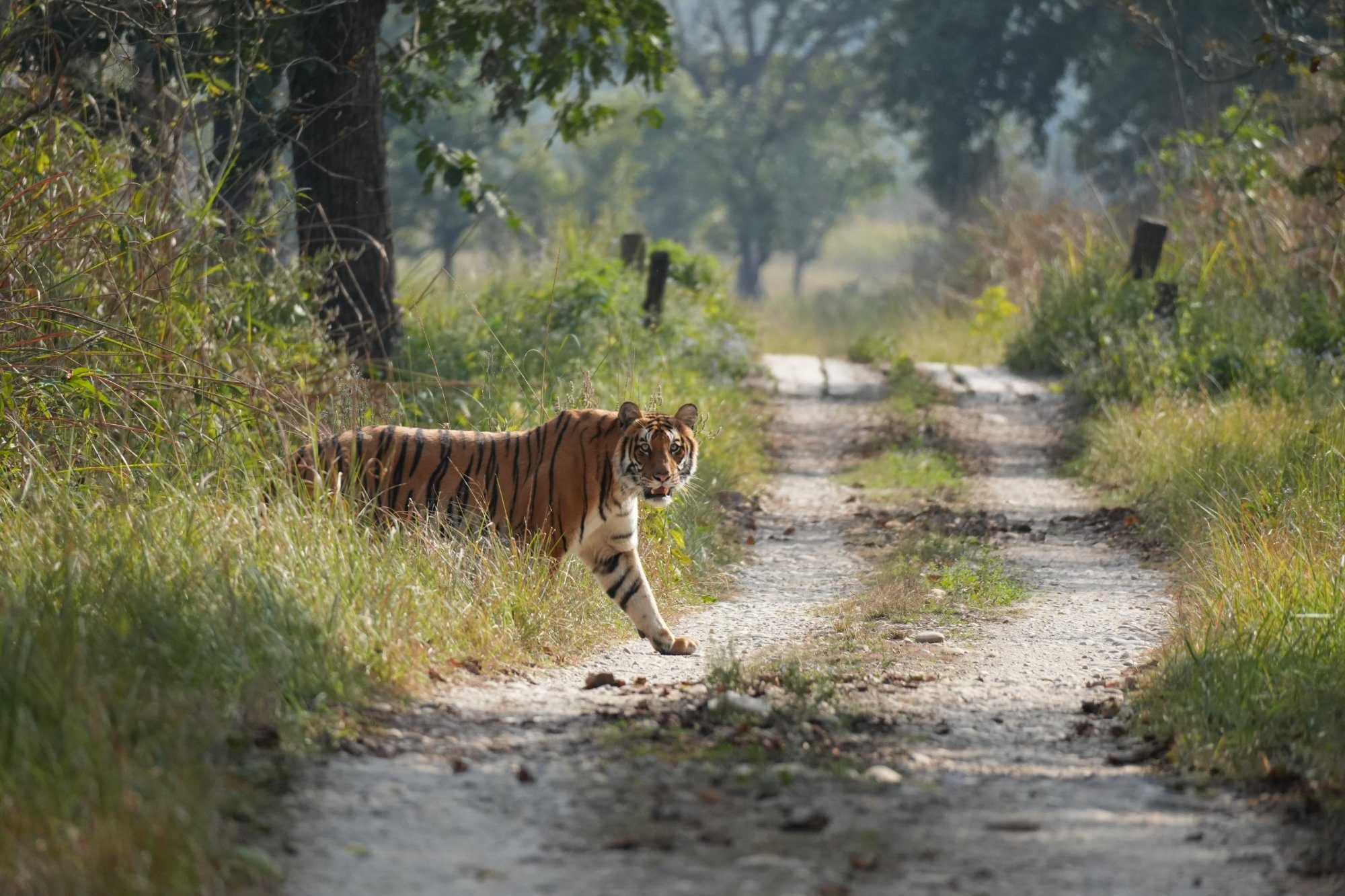
A tiger photograph from Bardia rarely looks like one from a reserve where tigers are used to vehicles. More often it is a face between stems of grass, a striped shoulder at the edge of the river, a tiger looking back over its shoulder before it steps into the sal. The light is low, the moment is short, and it is often taken by someone standing on the ground.
That is what makes it worth taking. This is a field guide for photographers coming to Bardia National Park, in Nepal's far west: what to bring, when the light is best, how to work on foot and from a vehicle, and how to keep the animal's wellbeing ahead of the picture.
The short answer
Bring one camera body you know well and one long lens, a zoom reaching about 500 to 600 mm or a fast 400 mm prime. Come between February and May, when the grass has been cut and tigers come to the rivers. Work at dawn and in the late afternoon. Expect to wait, and to shoot through grass and branches as often as in the open.
What to bring
The long lens. It is the one piece that matters most. A 150 to 600 or 180 to 600 mm class zoom covers almost everything in one lens; a 400 mm prime gathers more light in the forest's shade. On foot, keep the weight to what you can carry comfortably for several hours.
A second, shorter lens. Something in the 24 to 105 mm range for the river, the forest, the villages and the people you meet. Many of the strongest pictures from a journey like this are not of the tiger at all.
Support. In a vehicle, a bean bag on the rail steadies a long lens. On foot, a tripod is too slow and too noisy; a monopod or a steady hand is better.
Power and protection. Spare batteries and cards, a cover against dust in the dry months, and a dry bag for river crossings and the drift on the Karnali.
Binoculars. You will find more animals with your eyes than through the viewfinder.
Domestic flights to Nepalgunj carry tighter baggage limits than international ones. Your journey designer will tell you the allowance before you fly.
The light
Tigers move most at dawn and dusk, which is also when the light is best. In the dry season the sun is up early and strong by mid-morning; the first two hours and the last two are the hours that count. Under the sal canopy, even at midday, the light can drop sharply. Be ready to raise your ISO and accept some grain: a sharp, honest picture beats a clean, blurred one.
In the winter months, from December to January, mornings are often foggy. The fog makes soft, quiet pictures of the river and the forest, and slow starts for tigers.
On foot
Tracking a tiger on foot is the heart of a visit to Bardia, and it changes how you photograph.
- Shoot from your height. A tiger seen from the ground, at its own eye level, is a different picture from one seen from a vehicle above it.
- Stay quiet. Set your camera to silent shutter if it has one, and keep the beeps off.
- Stay in line. You walk in single file behind your naturalists. Never step out of line for an angle, and never move towards an animal for a closer frame. If your naturalists ask you to lower the camera and move back, do so at once.
- Use the waiting. Much of tiger tracking is sitting quietly above a river crossing. Set up, check your settings, and be ready long before anything happens.
From a vehicle and from the river
Days by open vehicle reach the grasslands and watchtowers, where you can work with more distance and more stability. On the river, drifting down the Karnali and Geruwa, the low angle suits gharial and marsh crocodiles on the sandbanks, kingfishers, and the forest edge in the evening light.
Composition in the forest
Bardia's forest rewards a different eye from the open savannah. Let the grass and leaves frame the animal; a tiger half seen through stems can be the stronger picture. Watch the background: a pale sandbank or dark water can lift a striped coat out of the scene. And keep shooting when the tiger turns away. The walk into the forest is often the picture.
The rules that protect the animal
The tiger's wellbeing comes before any photograph.
- No baiting, calling or chasing. We never lure an animal for a picture.
- No flash on wildlife.
- Keep your distance, as your naturalists set it.
- Drones need permission from the authorities in advance and are not flown over the park on our journeys.
- People first. Ask before photographing anyone in the villages, and respect a no.
What no photographer can be promised
A tiger cannot be promised, in any month, to any photographer. A good journey gives you time: four or five days in the forest, with the plan adjusted each day to the freshest sign. Our journey, Realm of the Tiger, is private, so the pace and the hours can be set around the light you want.
Questions we are often asked
What lens do I need to photograph tigers? A long lens reaching about 500 to 600 mm, or a fast 400 mm prime, plus a shorter lens for everything else.
When is the best light? The first two hours after sunrise and the last two before sunset, in the dry season from February to May.
Can I use a tripod on foot? It is too slow and noisy for tracking. Use a monopod or hand-hold, and a bean bag in the vehicle.
Can I fly a drone in Bardia? Not without permission from the authorities in advance, and we do not fly drones over the park.
Begin with a conversation
Tell us what you shoot with and what you hope to bring home. Your journey designer in Kathmandu will reply promptly and shape the days around the light. How we work sets out the rest.
Sources
- Lens advice for Nepal wildlife: FWF Field Journal, camera gear for Nepal wildlife photography.
- The "look-through" style of forest tiger photography: Nick Dale Photography, Africa or India.
- Season, light and grass: Magical Nepal and Nepal Tourism Board.
- Our journey, on foot, by vehicle and by river: Realm of the Tiger.
Realm of the Tiger
See the journey