

The Quiet Five: Nepal's Rarest Encounters, Privately Arranged
Africa has its Big Five. Nepal keeps a quieter list: the snow leopard, the red panda, the Bengal tiger, the one-horned rhinoceros, and one that is not an animal at all.
26 November 2026
Africa has its Big Five. They are loud, well known, and by now well attended. Nepal keeps a different list. Its great animals do not roar across open plains. They move through cloud forest, tall grass and high rock, and most of them would prefer not to be seen at all.
We call them the Quiet Five. Four are animals. The fifth is not, and we will come to it.
None of them can be promised. That is exactly why they are worth the journey, and why luxury wildlife journeys in Nepal are best made privately, with time in hand and the right people beside you.
1. The snow leopard, in Dolpo
In 2025 Nepal published its first national estimate of the snow leopard. The figure was 397. That is 397 animals spread across some of the highest, emptiest country on Earth.
Our search takes place in Dolpo, above the turquoise water of Phoksundo Lake, inside the largest national park in Nepal. Here we are honest about what success means. A sighting is exceptionally rare anywhere in the world. Most days are spent reading what the cat has left: a pugmark in dust, a scrape on a ridge, blue sheep suddenly alert on a slope.
What you are given instead of certainty is the company of trackers who have spent their lives on this ground, and a landscape that has barely changed in centuries.
When to go: October to November, and March to May.
The journey: Ghost of the Mountains
2. The red panda, in Langtang
The red panda is small, solitary and the colour of embers. It lives in the bamboo, rhododendron and fir of the middle mountains, between roughly 2,200 and 3,500 metres, and it spends most of its life in the trees.
Langtang, the national park closest to Kathmandu, holds some of its best surviving forest. You walk it with the local Forest Guardians who protect the animal, and who know which stands of bamboo were visited in the night. A helicopter opens the trail and another lifts you out from the sacred lakes of Gosaikunda, so every day between belongs to the forest.
When to go: October to November, and March to April.
The journey: Ember of the Mist
3. The Bengal tiger, on foot in Bardia
Nepal's tigers are one of the great conservation stories of our time. In 2009 the country counted 121. The national census of July 2026 counted 429.
Bardia, in the far western lowlands, is the largest and least disturbed national park on Nepal's plains, and the finest place in the country to track a wild tiger on foot. You walk with naturalists and Tharu guides who read pugmarks and listen for the alarm call of a deer. The days move between walking, open safari vehicles and a slow drift on the Karnali, so the search follows the animal and never the timetable.
When to go: October to April.
The journey: Realm of the Tiger
4. The one-horned rhinoceros, at the river
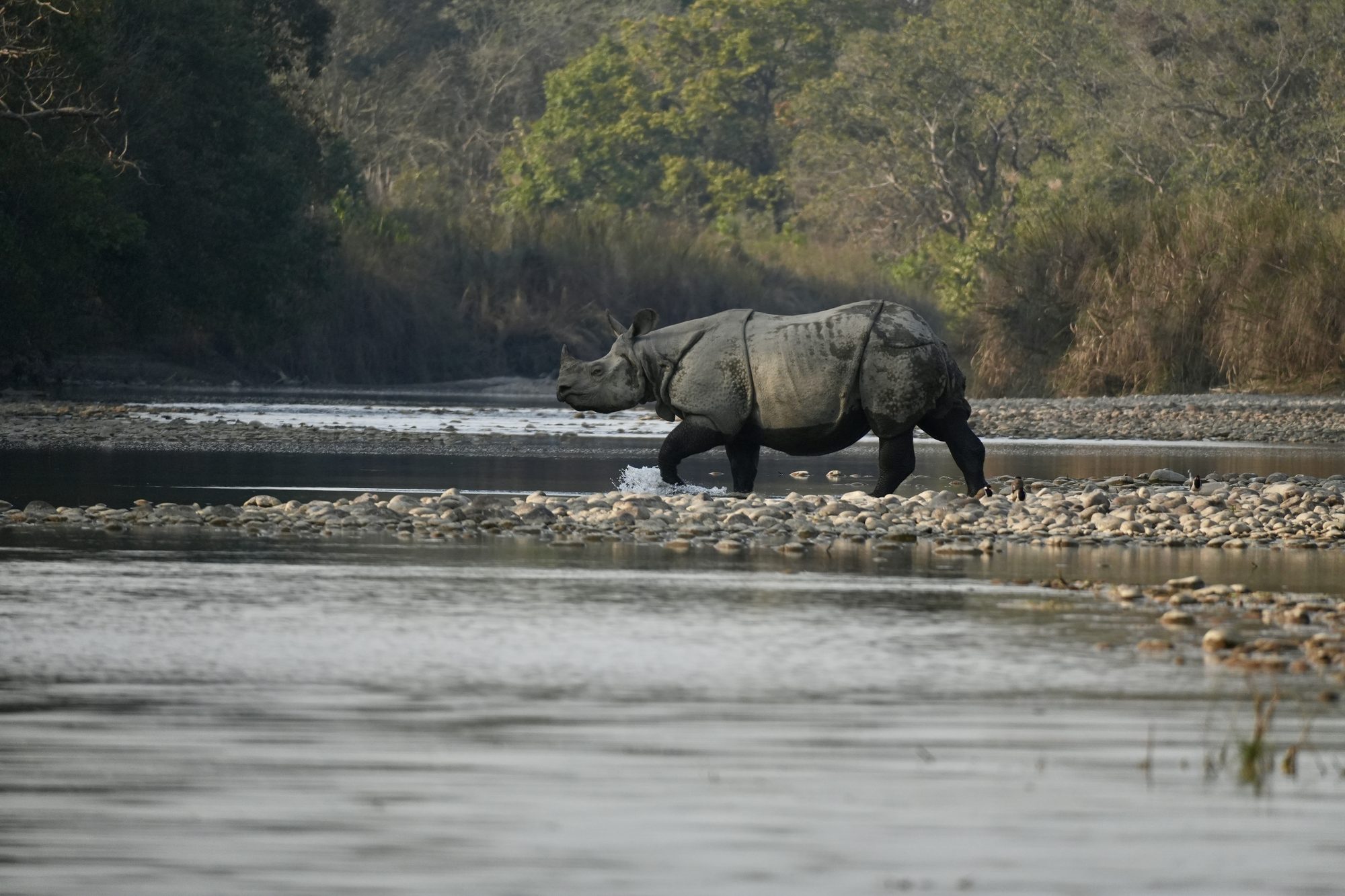
The greater one-horned rhinoceros looks like something drawn from memory by a medieval artist: armour plates, a single horn, a calm and prehistoric walk. Nepal's last national count, in 2021, found 752.
In Bardia you meet it where it is most itself, at the water's edge in the early light, with no line of vehicles and no hurry. The same river is home to the Gangetic dolphin, one more reason the Karnali rewards those who sit still.
When to go: October to April, on the same journey as the tiger.
5. The dark
The fifth is not an animal. It is darkness, which has become one of the rarest things a traveller can be given.
Near Tserko Ri, at almost 5,000 metres, there is close to no artificial light, and the dry, still air of autumn and spring lets the deep sky through. We time the high camp to the new moon, so the Milky Way appears as it did to everyone who ever lived before the electric lamp. An astronomy guide and telescopes are there for those who want them. Many guests simply lie back and look.
When to go: October to November, and March to April, in the new-moon windows.
The journey: River of Stars
Why these journeys are private
Rare animals do not wait for a schedule. A tiger that crosses the track at dawn will not cross it again at ten. A snow leopard may show itself on the one day a larger party would have moved on.
A private journey bends. You stay another day where the sign is fresh. You leave before first light, or not at all. Your naturalist answers to you alone, and so does the helicopter. That freedom is the real luxury of wildlife travel in Nepal, and it is the way every one of our journeys is composed.
What your journey leaves behind
Each of these animals is alive in Nepal today because people in the valleys chose to protect it. A part of what you spend remains with them: the trackers, the forest guardians, the communities at the edge of the park. You can read how on our Conservation page.
Begin with a conversation
Tell us which of the Quiet Five you would most like to meet, and when you are free to travel. Your journey designer in Kathmandu will reply promptly, and compose the rest around you.
Realm of the Tiger
See the journey