

Your Second Safari: A Tiger After Africa
For travellers who know Africa: what a private tiger safari in Nepal feels like, what is familiar, what is new, how the seasons fit, and the Himalaya beside it.
27 November 2026
You have sat by a fire in the Okavango and listened to lions call across the water. You have watched the herds cross the Mara. Perhaps you have walked in South Luangwa behind a tracker with a rifle on his shoulder. Africa has given you the great plains and the Big Five.
It cannot give you a wild tiger. For that, you come to Asia. This is for the traveller who knows Africa and wonders what a second safari, in Nepal, would be like.
The short answer
A tiger safari in Nepal is quieter, slower and more intimate than a safari in Africa. You see fewer animals, and you work harder for each one. The cat at the centre of it is the most secretive of all, and in Bardia National Park, in Nepal's far west, you track it on foot. The days end not on a savannah but beneath the Himalaya, which you can add to the same journey.
What will feel familiar
Much of the rhythm is the same. The day begins before dawn and ends at dusk, with the heat of the afternoon spent resting. You go out by open vehicle and on foot, with naturalists who read the ground and the sounds of the forest. The alarm calls that tell you a cat is near, a deer barking, a monkey coughing in the canopy, will feel like the language of the bush you already know.
You may see a rhino, though a different one: the greater one-horned rhinoceros of the Terai, armoured in great folds of skin. You may meet wild elephants, crocodiles on the riverbanks and a leopard on a forest track.
What will be new
The forest. Africa's great reserves are largely open. Bardia is a mosaic of sal forest, riverine woodland and tall grass along the Karnali, Nepal's longest river. You see less at a distance and more up close. Until the grass is cut in winter, it can stand taller than a person.
The cat. A lion pride lies in the open. A tiger hunts alone, moves at dawn and dusk, and is rarely seen in daylight for long. Most of tiger tracking is reading sign and waiting. When a tiger appears, often at a river crossing or on a sandbank, the moment is brief and complete.
The walk. In much of Africa, walking is a speciality of particular camps. In Bardia it is the heart of the day. You follow pugmarks along the river in the early morning and settle in to wait where the signs point.
The odds. A good safari in Africa promises a great deal and usually keeps the promise. A tiger cannot be promised anywhere. Bardia gives good odds over several days, and they are best from February to May. We would rather say so now than after you arrive.
The people. Bardia is the home of the Tharu, who have lived beside this forest for generations. A day with them, their houses of mud and thatch, their food and their festivals, gives the journey a depth that a safari camp rarely can.
The houses
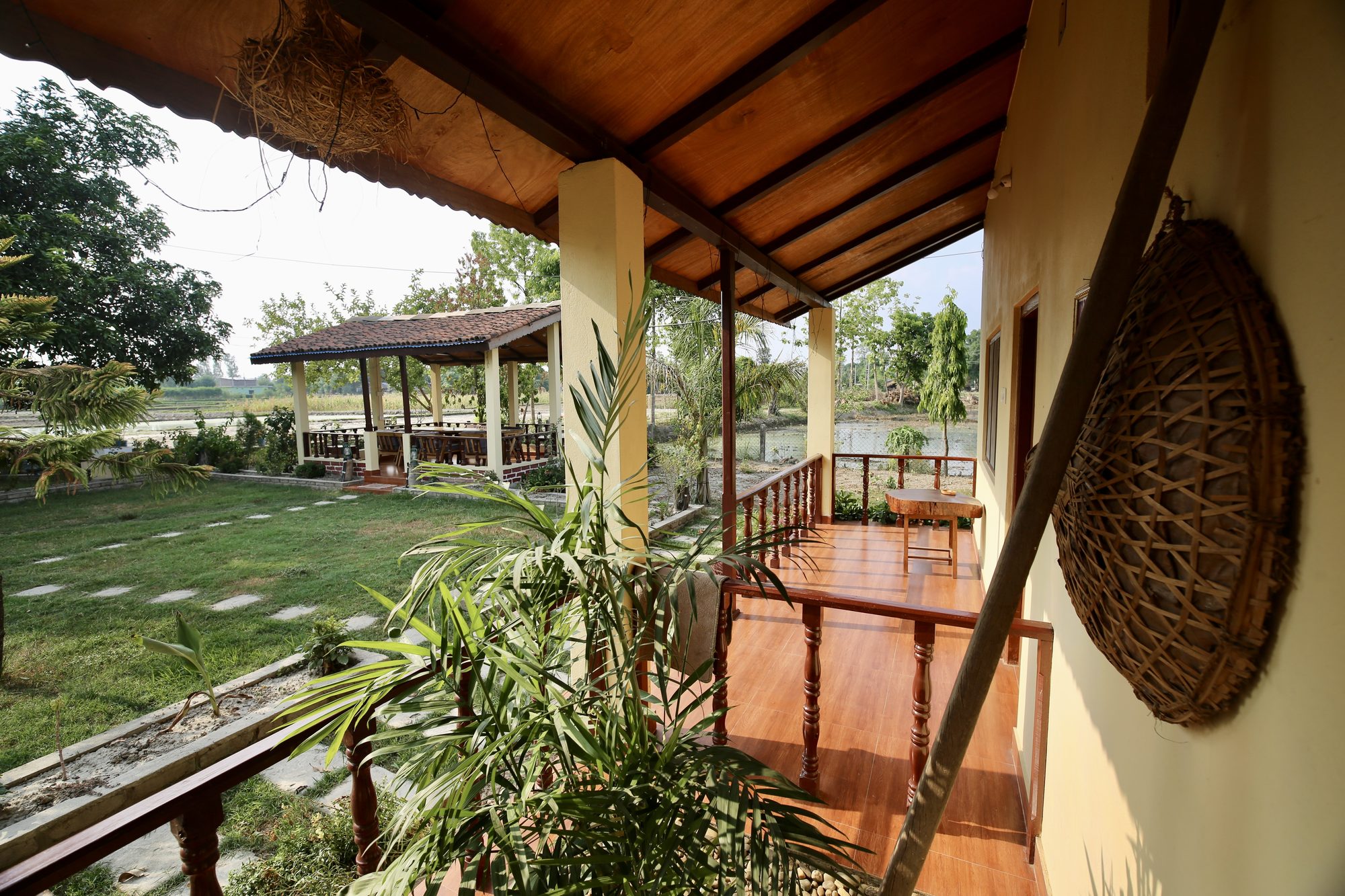
In Bardia we stay at Tiger Tops Karnali Lodge, at the edge of the park. Tiger Tops opened Nepal's first wildlife lodge in the 1960s. The lodge is intimate and quiet rather than grand. If you have stayed in Africa's finest camps, expect something simpler, warmer and closer to the forest, with the river at the end of the path.
In Kathmandu, before and after the forest, you stay in the houses of our collection: The Dwarika's, built around carved wood rescued from the old valley, or The Soaltee.
How the seasons fit
East Africa's busiest months run from July to October, the season of the river crossings. Southern Africa's dry season runs from about June to October. Bardia's best months for tigers are February to May, when the grass has been cut and the animals come to the river.
The two do not compete. A traveller can spend the northern summer in Africa and the late winter or spring in Nepal, in the same year, at the best time for each.
The mountains beside it
No African safari ends beneath the Himalaya. In Nepal the forest and the mountains are a short flight apart. A tiger journey can begin with Kathmandu's old courtyards and end with a flight along the great peaks, a few days in a high valley, or a longer journey further in:
- Ghost of the Mountains, in search of the snow leopard, the second great cat of Nepal.
- Kailash 2027, the pilgrimage around the sacred mountain in western Tibet.
Private by design
Every GLOCAL Village journey is private: for you and the people you travel with, on the dates you choose. Your journey designer in Kathmandu shapes the days around you and stays with you from the first message to the last night. How we work sets out the rest.
Questions we are often asked
Is a tiger safari like an African safari? In rhythm, yes: early starts, open vehicles, naturalists, alarm calls. In feel, no: it is quieter, in forest rather than on open plains, with more time on foot and fewer, rarer sightings.
Is Nepal good for a second safari? For a traveller who has seen Africa's plains and wants a wild tiger, the walk, and the Himalaya in the same journey, it is one of the best.
When should I go? February to May for the best chance of a tiger. The season opens in October.
Can I add the Himalaya? Yes. Kathmandu, a mountain flight, the snow leopard or Kailash can all be joined to the same journey.
Begin with a conversation
Tell us where you have been on safari, and what you hope to find this time. Your journey designer will reply promptly and compose Realm of the Tiger around you.
Sources
- African seasons: Adventure Out Loud, November 2026.
- Walking safaris in South Luangwa: Bushcamp Company.
- Bardia's wildlife, vegetation and seasons: Nepal Tourism Board and Magical Nepal.
- Rhinos in Bardia: Mongabay, June 2026.
- Tiger Tops Karnali Lodge: Tiger Tops.
- Our houses and journeys: the Realm of the Tiger page.
Realm of the Tiger
See the journey