

The Potala Palace and Two Unhurried Days in Lhasa
The Potala Palace, the Jokhang, the Barkhor and the debating monks of Sera: how to see Lhasa well in two days at 3,656 metres, before the road west.
27 November 2026
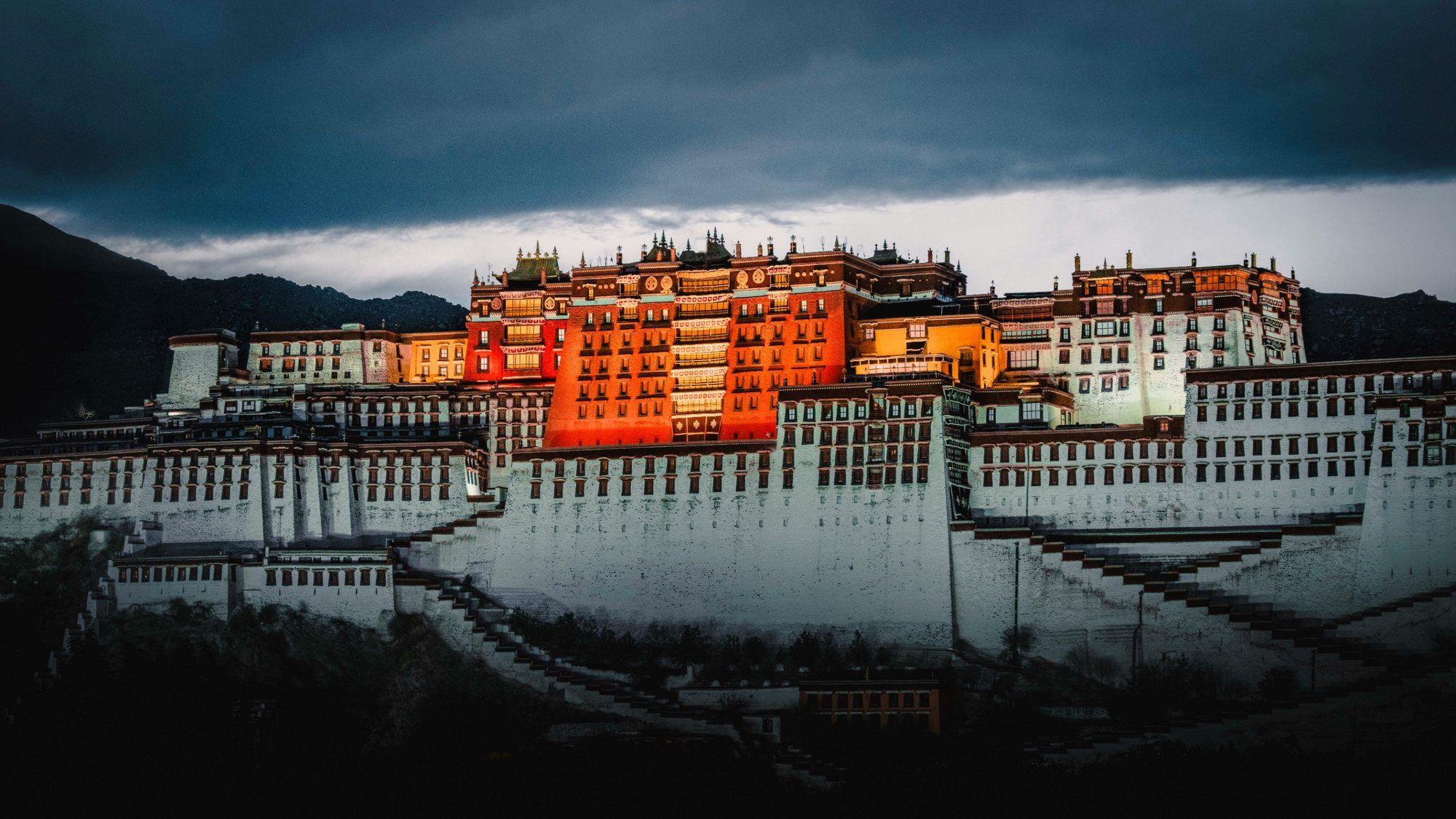
The Potala Palace rises thirteen storeys above Lhasa, white walls and red, on the hill at the centre of the valley. For three centuries it was the winter palace of the Dalai Lamas, and it remains the image of Tibet that most travellers carry home. It is also climbed by long stone stairways at about 3,700 metres. How you see it, and the rest of Lhasa, depends on taking your time.
The short answer
- What it is: the former winter palace of the Dalai Lamas, begun in 1645 on the site of a seventh-century palace, now a museum.
- Size: thirteen storeys and more than 1,000 rooms, rising 119 metres above its hill.
- World Heritage: listed by UNESCO in 1994, together with the Jokhang and the Norbulingka.
- Visiting: entry is by advance booking, in timed groups, and visits inside are short. Your guide holds the booking.
- When: not on the day you arrive. Give the body a night first.
The palace on the red hill
The first palace on this hill is attributed to Songtsen Gampo, the first emperor of Tibet, in the seventh century. The building you see today was begun in 1645 by the Fifth Dalai Lama. The White Palace, the Potrang Karpo, was completed first, and the Dalai Lama and his government moved into it in 1649. The Red Palace, the Potrang Marpo, at its heart, was added between 1690 and 1694. It holds the great halls, the chapels and the golden tombs of past Dalai Lamas.
The walls slope inward and are three metres thick on average. Copper was poured into the foundations against earthquakes. Inside are some 10,000 shrines and around 200,000 statues. The palace served as the Dalai Lamas' winter residence until 1959 and has been a museum since.
Seeing it well
The number of visitors each day is limited, and the quota is often reached by mid-morning in summer. Entry is booked in advance, in your own name, for a set time, and the visit inside moves at a steady pace. We hold the booking for you, choose a time when you are rested, and climb the stairways slowly, with pauses, as Tibetan pilgrims do.
The finest view of the palace is not from inside it. It is from across the square at dusk, or from the rooftops of the old town, when the lights come on along its walls.
The Jokhang and the Barkhor
If the Potala is the seat of power, the Jokhang is the heart of faith. Founded in the seventh century, it is the most sacred temple in Tibet, and pilgrims come from every corner of the plateau to stand before its statue of the Buddha at the age of twelve, the Jowo Shakyamuni. The smell of butter lamps fills the halls, and the floor before the gate is worn smooth by prostrations.
Around it runs the Barkhor, the old pilgrim circuit through the heart of the city. Walk it clockwise, with the pilgrims, turning prayer wheels as you pass. It is almost level, and the best first walk in Lhasa.
Sera and the Norbulingka
At Sera Monastery, on the city's northern edge, the monks debate in a walled courtyard under the trees on most afternoons, from about three until five, except on Sundays and some festival days. Questions are put with a clap of the hands and a stamp of the foot; answers are defended with equal force. Visitors may watch quietly from the edge.
The Norbulingka, the summer palace of the Dalai Lamas, lies in gardens to the west of the city. After the stairways of the Potala, its paths are a gentle way to end a day.
Two days, as we shape them
On the day you land, nothing. Rest, a light dinner, and an early night at one of the finest hotels in our collection: the St. Regis, the Shangri-La or the InterContinental. Our note on the first 48 hours in Lhasa explains why.
The next day, the city at walking pace: the Jokhang and the Barkhor in the morning, the Potala at your booked hour, and Sera for the afternoon debate, or the Norbulingka if you would rather sit in a garden. The day after, the road west begins.
Questions we are often asked
How long does a Potala Palace visit take? The visit inside is kept short, usually about an hour, and moves at a set pace. Allow more time for the climb up and the walk down.
Do you need to book the Potala Palace? Yes. Daily numbers are limited, and entry is by advance booking. Your Tibet operator arranges it with your permits.
When do the monks debate at Sera? On most afternoons from about 3 to 5 pm, except Sundays and some festival days. Times can change, and your guide confirms them on the day.
How many days do you need in Lhasa? At least two nights before going higher, for the altitude as much as for the sights. Three is better if you have the time.
Begin with a conversation
Lhasa opens our journey to Kailash 2027, and it can be lengthened as you wish. Tell us how much time you would like in the city, and your journey designer will compose the days around you.
Sources
- Construction from 1645, Songtsen Gampo, the White Palace (1649) and Red Palace (1690 to 1694), thirteen storeys, 1,000 rooms, 10,000 shrines, 200,000 statues, 119 metres, the walls and copper foundations, altitude of about 3,700 m, residence until 1959, UNESCO listing in 1994 with the Jokhang (2000) and Norbulingka (2001), and the daily quota often reached by mid-morning: Potala Palace, Wikipedia.
- Real-name advance reservation by your operator, a visit inside of about an hour, and not on the day of arrival: China Dragon Travel, Potala booking guide 2026 and Eastbound Travel, Potala visiting guide 2026.
- The Jokhang, its oldest part built in the 650s by Songtsen Gampo, and the Jowo Shakyamuni as the Buddha at twelve: Jokhang, Wikipedia.
- Sera debate times: Tibet Vista, Sera Monastery debate and Access Tibet.
- Hotels and the Lhasa days: our Kailash 2027 page.
Every journey begins with a conversation.
Plan a journey