

Bardia National Park: A Guide for the First Visit
Where Bardia is, how to get there, when to go, what lives there and how a visit works: tigers, rhinos, the Karnali, the Tharu. A guide from Kathmandu, 2026.
27 November 2026
Bardia National Park lies in the far west of Nepal's lowlands, where the Karnali, the country's longest river, comes down out of the hills and spreads across the plain. It is the largest national park in the Terai and one of the quietest, and it is the place in Nepal where travellers come to track a wild tiger on foot.
This guide covers what a first visit needs: where the park is, how to reach it, when to go, what lives there, how the days work, and what we have learned from planning journeys there.
At a glance
| Where | Western Nepal, in the lowlands of the Terai, on the Karnali river near the Indian border |
|---|---|
| Size | 968 km², the largest national park in Nepal's lowlands |
| Protected since | 1976 as a wildlife reserve; a national park since 1988 |
| Gateway | Thakurdwara, where the park headquarters stands |
| Altitude | About 150 metres above the sea |
| Tigers | 112 (2026 census) |
| Best season | October to May; February to May for tigers |
| How long | Four or five days in the forest |
The official spelling is Bardiya. Most travellers write Bardia, and so do we.
The landscape
Bardia is not one forest but several. Most of the park is sal forest, tall and straight, where the light comes down in shafts. Along the rivers it opens into riverine woodland and broad sandbanks. Between them lie the phantas, open grasslands such as Bagora Phanta and Lamkauli, where deer graze in the evening and tigers hunt at their edges.
To the west runs the Karnali and its branch, the Geruwa. To the north rise the Siwalik hills, the first low ridge of the Himalaya. Beyond them lies the Babai Valley, a quieter, wilder part of the park, reached on foot or on a longer day.
What lives here
The park holds more than 30 species of mammal, and more than 400 species of bird have been recorded in and around it. Together with neighbouring Banke National Park, it forms a single protected area of 1,437 km² for tigers.
- The Bengal tiger. 112 in the 2026 national census, the second-largest population in Nepal.
- The greater one-horned rhinoceros. 38 at the last count, all descended from animals moved here from Chitwan since 1986. They are harder to see than in Chitwan.
- Wild Asian elephants, including bulls that roam between the park and the forests beyond it.
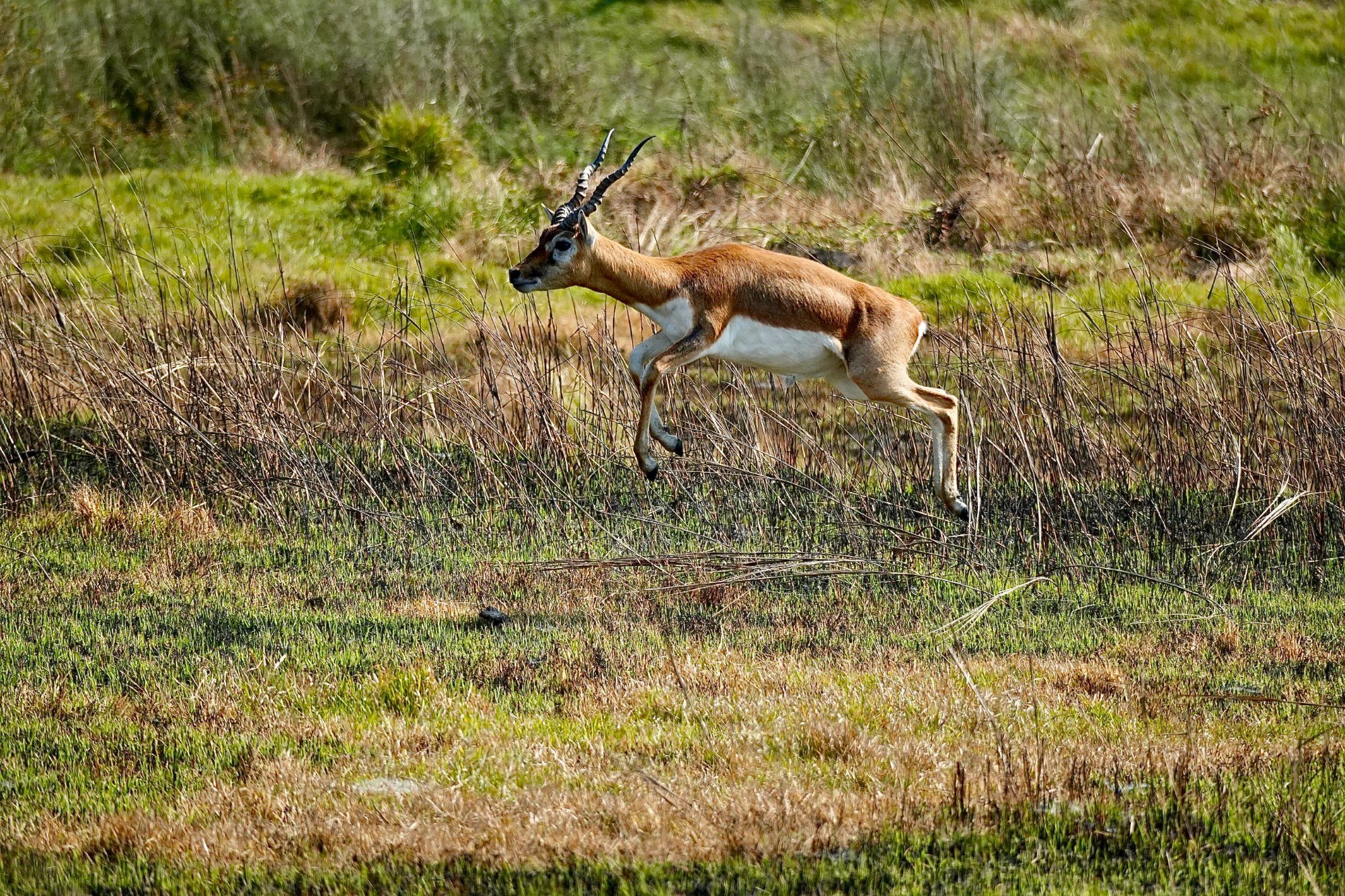
- The leopard, sloth bear, swamp deer, spotted deer, sambar and blackbuck.
- On the rivers: the gharial, a slender-snouted crocodile found only in South Asia, and the marsh mugger crocodile.
- Birds from the Bengal florican and the sarus crane to kingfishers, eagles and owls.
The Ganges river dolphin needs an honest note. The Karnali was long one of its strongholds in Nepal. Surveys reported in December 2025 found only three in the main river and one in the Geruwa. A sighting is now a rare gift, and the decline is a warning about water in the river.
How to get there
From Kathmandu, the usual way is by air. The flight to Nepalgunj takes about an hour. From there, the road runs about 95 km west to the park, about three hours by car.
By road from Kathmandu, the journey takes 14 to 16 hours. We do not recommend it unless it is part of a longer journey across the lowlands.
When to go
The park's main season runs from October to May.
- October to January. Cool, clear days and cold, often foggy mornings. The grass is still tall early on, then cut in winter.
- February to May. The best time for tigers. The grass has been cut, water is scarce, and animals come to the rivers. From April the afternoons are very hot, up to the low forties Celsius.
- June to September. The monsoon. Rivers rise, grasslands flood, and drives into the park pause.
The park can close for single days. In March 2026 it closed for two days for timber collection. We plan around these.
How a visit works
Every visit inside the park is made with a licensed guide. In Bardia the days move between three ways of being in the forest:
- On foot, tracking with naturalists, reading pugmarks and alarm calls, and waiting where a tiger is likely to cross.
- By open vehicle, for longer distances, to the grasslands and to watchtowers such as the Balcony, above the open phantas.
- By river, drifting down the Karnali and Geruwa for gharial, crocodiles and birds.
On our journey, Realm of the Tiger, the three days in the forest move between all three as the signs decide, with a fourth day with the Tharu.
The Tharu
The villages around the park are home to the Tharu, the people of the Terai, who have lived beside this forest for generations. Their houses of mud and thatch, painted walls, fishing and food are part of any visit to Bardia. In Dalla, at the edge of the park, Tharu families have run a community homestay since 2010. Time with the Tharu, and with the patrols who protect the park, is part of understanding why Bardia's tigers recovered.
Where to stay
Lodges cluster around Thakurdwara, at the park's edge. They range from simple guesthouses to intimate lodges. We stay at Tiger Tops Karnali Lodge, at the edge of the park, from Tiger Tops, who opened Nepal's first wildlife lodge in the 1960s.
What to bring
Quiet greens and browns for the walks, long light sleeves and trousers, closed shoes you can wade in, a hat, sun cream, binoculars, and a warm layer for winter mornings. The rules are simple: no drones without permission, no feeding animals, no straying from your naturalists.
How many days
At least three nights. Four or five if a tiger is your aim. Tracking on foot rewards repetition: the same riverbank on several mornings, a second visit to a crossing where fresh sign appeared.
Questions we are often asked
Where is Bardia National Park? In western Nepal, in the lowlands of the Terai, on the Karnali river near the Indian border, about 95 km west of Nepalgunj.
How do you get to Bardia? Fly from Kathmandu to Nepalgunj, about an hour, then drive about three hours to the park.
How many days do you need? At least three nights, and four or five to give yourself a good chance of a tiger.
Is Bardia or Bardiya correct? Both. Bardiya is the official spelling; Bardia is the more common one.
Can you see dolphins in Bardia? Rarely now. Only three or four Ganges river dolphins were found in the Karnali and Geruwa in the latest survey.
Begin with a conversation
Tell us when you would like to visit, and with whom. Your journey designer in Kathmandu will reply promptly and compose Realm of the Tiger around you. How we work sets out the rest.
Sources
- History, size, landscape, birds and the Bardia-Banke protected area: Wikipedia, Bardiya National Park.
- Access, wildlife, seasons and park headquarters: Nepal Tourism Board.
- Tigers, 2026: Kathmandu Post.
- Rhinos and translocations since 1986: Mongabay, June 2026.
- Dolphins: Kathmandu Post, 22 December 2025.
- Road time from Kathmandu: National Parks of Nepal.
- Dalla homestay since 2010: WWF Nepal.
- Park closure, March 2026: Bardia National Park notice.
- Grass cutting and the tiger season: Magical Nepal.
Realm of the Tiger
See the journey